For two years, “AI automation” mostly meant chatbots and generic copilots bolted onto existing software. In 2026, that has changed in a big way. AI automation has grown up — moving from tools that suggest to systems that act. Here's what actually changed this year, and what it means for your business.
1. From assistants to agents
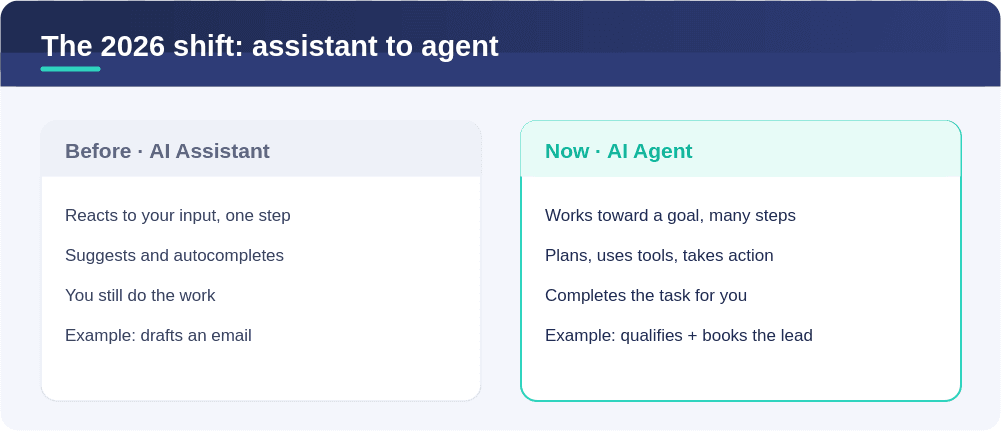
The single biggest change is the rise of agentic AI. In 2024, AI automation meant “suggest an email draft.” In 2026, it means “qualify this lead, write the outreach, schedule the follow-up, and update the records — on its own.”
This is the shift from AI assistants (which recommend or autocomplete) to AI agents (which plan a task, use your tools, and complete it across multiple steps). Automation is no longer just following fixed rules — it's making decisions and taking action.
2. From experiments to production
AI automation moved out of the “let's test it” phase and into real operations. By early 2026, around 80% of enterprises had at least one production application with an embedded AI agent — up from roughly a third just two years earlier. Analysts expect a large share of enterprise software to include task-specific AI agents by the end of the year.
In other words, agentic automation stopped being a science project and became part of how companies actually run.
3. From hype to proof (ROI matters now)
With adoption came a demand for results. In 2026, businesses stopped asking “can AI do this?” and started asking “what's the return?” Leaders now expect AI automation to show measurable impact — hours saved, faster processing, lower costs, better customer service — before they invest further.
This is a healthy change. The winners in 2026 aren't the companies with the flashiest demos; they're the ones who can prove their automation moved a real number.
4. From isolated tasks to connected workflows
AI automation in 2026 is about connection. Instead of automating one task in one app, businesses are linking their tools — CRM, support, marketing, finance — so agents can run entire workflows end to end. Automation only delivers real value when it's integrated with your actual systems and data.
At the same time, no-code and low-code tools have made automation accessible beyond developers, so more teams can build workflows themselves.
5. From “capability” to “control”
As agents took on real work, governance became the priority. The question in 2026 is no longer whether AI can do something, but how to do it safely — with the right oversight, transparency, and human checkpoints. Responsible, well-governed automation is now the difference between a project that scales and one that gets shut down.
The honest reality: narrow beats ambitious
Here's the part the hype skips. Not every AI project is succeeding. Analysts estimate a large share of agentic AI projects will be cancelled in the next couple of years — usually because of unclear ROI or weak controls. The lesson isn't “automate everything.” It's the opposite.
The businesses winning with AI automation in 2026 pick one process with clear inputs, clear outputs, and a human checkpoint — and automate that end to end before touching anything else. Start narrow, prove the value, then expand.
What this means for your business
If you've been waiting to adopt AI automation, 2026 is the year it became practical and proven — but only if you approach it the right way:
- Don't try to automate a whole department. Pick one high-value, repetitive workflow.
- Connect the automation to your real tools and data.
- Measure the result, then scale what works.
That's exactly how we work at BrainBox Automations: we build AI agents and automations around one high-impact workflow at a time — connected to your CRM, data, and tools — and designed to prove ROI before you scale.
Frequently Asked Questions
What is agentic AI?+
Agentic AI describes systems that don't just answer questions or autocomplete fields — they plan a goal, use tools, and complete multi-step tasks autonomously. It's the defining shift in AI automation in 2026.
How is AI automation in 2026 different from before?+
It moved from assistants that suggest to agents that act, from experiments to production use, and from hype to a focus on measurable ROI and governance.
Is AI automation only for big enterprises?+
No. While large enterprises led adoption, no-code tools and affordable AI features have made automation practical for small and mid-sized businesses too.
Where should a business start with AI automation?+
Start with one repetitive, high-value workflow that has clear inputs and outputs. Automate it end to end, measure the result, then expand.
Why do some AI automation projects fail?+
Usually because of unclear ROI or weak controls — trying to automate too much, too fast, without a defined goal. Narrow, well-scoped projects with human oversight succeed far more often.
Put AI automation to work the right way
The winners in 2026 start narrow: one process with clear inputs, clear outputs, and a human checkpoint — automated end to end before expanding. BrainBox Automations builds AI agents around one high-impact workflow at a time, connected to your CRM, data, and tools, and designed to prove ROI before you scale.