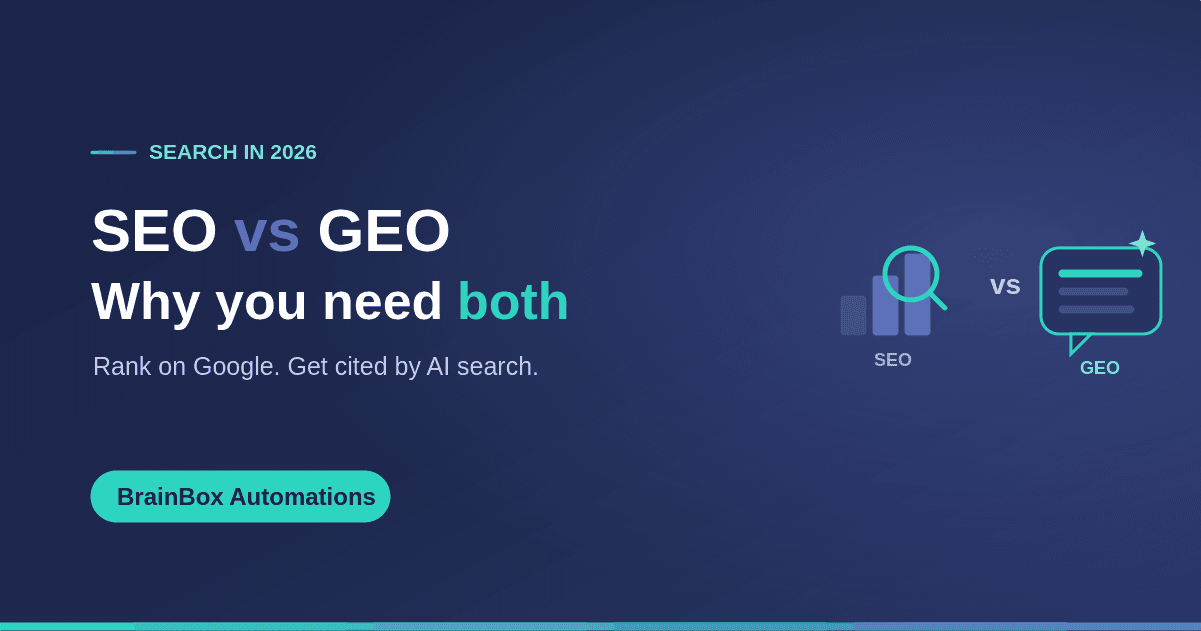
For twenty years, getting found online meant one thing: ranking on Google. That's still important, but it's no longer the whole story. More and more people now ask ChatGPT, Perplexity, or Google's own AI for answers instead of scrolling through a list of links. That shift has created a second discipline sitting alongside SEO, called GEO. This guide explains what SEO and GEO are, how they differ, and why your business needs both in 2026.
What is SEO?
SEO (Search Engine Optimization) is the practice of optimizing your content so it ranks higher on search engine results pages, like Google. The goal is simple: show up near the top when someone searches a relevant term, so they click through to your site. Success is measured in rankings, clicks, and organic traffic.
SEO relies on things like keyword research, quality content, a fast and well-structured website, and backlinks from other sites.
What is GEO (and AEO)?
GEO (Generative Engine Optimization) is the practice of structuring your content and brand so that AI-powered engines like ChatGPT, Perplexity, Google AI Overviews, Gemini, and Claude cite, reference, and recommend you in their answers. You'll also hear it called AEO (Answer Engine Optimization); the two terms are used interchangeably.
The difference from SEO is the goal. SEO is about ranking a page so people click it. GEO is about becoming one of the sources an AI trusts and quotes when it answers a question, often without the user clicking anything at all. In short: SEO ranks pages, GEO powers answers.
SEO vs GEO: the key differences
| Aspect | SEO | GEO |
|---|---|---|
| Where you show up | Google search results | AI answers (ChatGPT, Perplexity, AI Overviews) |
| The goal | Rank the page, earn the click | Get cited inside the AI's answer |
| Main metric | Rankings, clicks, traffic | Brand mentions and citations in AI answers |
| How users arrive | They click your link | They read your brand inside an answer |
| Driven mostly by | On-page SEO + backlinks | Clear, factual content + brand authority across the web |
They work together, not against each other
Here's the most important point: GEO is not replacing SEO, and you don't choose one over the other. They build on each other. Strong SEO performance directly feeds GEO, because AI engines pull from well-structured, credible content that already performs in search. A site that's good at SEO has a real head start at GEO.
So the right approach in 2026 isn't “SEO or GEO.” It's both, as one connected strategy.
How to optimize for both
The good news is that most of the work overlaps. A few practices cover both SEO and GEO:
- Write clear, factual, quotable content — AI engines lift direct, definitive sentences straight into answers, and clear content ranks well too. Research into GEO found that adding statistics can boost a page's visibility in AI answers by up to around 40%, and adding citations and quotations by up to around 41%.
- Lead with the answer — put a direct, concise answer near the top of the page. It helps both search snippets and AI citations.
- Use a question-and-answer structure — FAQ sections match how people search and how they ask AI engines, and they're easy for AI to quote.
- Add schema markup — structured data (FAQ, Article, Organization) helps both Google and AI engines understand and reuse your content.
- Build topic depth — clusters of related, internally linked content signal authority to search engines and get cited more by AI.
- Grow brand authority across the web — GEO is largely a third-party game. Mentions, reviews, and citations on other reputable sites teach AI engines that your brand is credible.
Why this matters now
AI search is growing fast, and users increasingly get their answers directly from an AI rather than a list of links. Traffic that does come from AI answers often converts better, because those users arrive already informed and further along in their decision. Businesses that start optimizing for AI answers early will be the ones cited as the trusted source, while competitors are still focused only on blue links.
In other words, SEO keeps you visible on Google, and GEO keeps you visible in the AI answers that are quietly taking over how people search. You need both.
Getting found on search and AI search
Being found in 2026 means showing up in two places: traditional search results and AI-generated answers. The content and brand signals that earn one increasingly earn the other, which is why the smartest approach treats SEO and GEO as a single strategy. At BrainBox Automations, we're helping businesses build content designed to perform in both.
Frequently Asked Questions
What is the difference between SEO and GEO?+
SEO optimizes your content to rank and earn clicks in traditional search results like Google. GEO (Generative Engine Optimization) optimizes your content and brand so AI engines like ChatGPT and Perplexity cite you inside their answers. SEO ranks pages; GEO powers answers.
Is GEO replacing SEO?+
No. GEO is an extension of SEO, not a replacement. Strong SEO directly supports GEO, and the best strategy uses both together.
What is AEO?+
AEO (Answer Engine Optimization) is another term for GEO — optimizing content to be used in AI-generated and answer-based results. The two are often used interchangeably.
How do I optimize for AI search?+
Write clear, factual, quotable content with a question-and-answer structure, add statistics and citations, use schema markup, build topic depth, and grow brand mentions across reputable sites.
Why does GEO matter in 2026?+
More people now get answers directly from AI engines instead of clicking search results. Optimizing for GEO means your brand is cited as a trusted source in those answers, not left out of them.
Want your business to show up in both Google and AI search?
SEO keeps you visible on Google; GEO keeps you visible in the AI answers that are quietly taking over how people search. The signals that earn one increasingly earn the other, so the smartest approach treats them as a single strategy. BrainBox Automations is helping businesses build content designed to perform in both.